Thursday, January 26, 2012

[2012 trends] Brand purpose to take lead in brand strategy

Brands can no longer rely solely on gaining consumers at pre-purchase with TV commercials to guarantee success. Products and brands aren't differentiated merely on functional or even emotional propositions anymore. You may think you can shout all you want with your advertising and sponsorships: no one will buy.


Authentic brand value


We are moving into the era of calculated, monitored and measured authentic brand value... delivered by positive brand experiences or brand engagements in both the online and offline environments, where advertising and PR just merely amplify these experiences.


Consumers are looking to brands that add real tangible value to their lives; clients are looking to us (as their agencies) to deliver real money-making value to their marketing strategies and their business as a whole (internally and externally); and employees are looking to us to deliver real motivations to their role within that organisation and the brands it serves.


The brand now needs not only to represent its product but the people behind the product and why they do what they do for that product's success.


Driving factors


The factors driving this desire for value are numerous and varied, depending on who you are talking to, so you need to consider the main influences driving the value era:
  1. Rising expectations

    The global recession and its aftermath have destroyed people's trust in companies and brands to the core. Consumers are wiser and will continue to rise up against the unethical or greedy companies.
  2. The rise of Gen Y and Gen Z

    These generations are the future markets. They are optimistic, entrepreneurial and the most socially connected generation ever. They bring a new mind-set. They want to do well by 'doing good' and see themselves with a mandate to affect positive social change.
  3. Competitive and government pressures

    Legal requirements and competitive pressures are forcing businesses to disclose everything, from carbon footprint to labour practices. 
  4. The race for resources

    We all know that we are facing looming shortages of various crucial resources but demand for them continues to increase exponentially. Businesses and brands, therefore, have a moral responsibility to ensure the sustainability of these resources for future generations.
  5. Connected conversations

    Social media has fundamentally changed the way we communicate and engage. Consumers are talking to each other before talking to the brand, and trusting total strangers. Friendtelligence is driving choice; brands, therefore have to drive positive talkability, both in the online and offline world (equally well), to have any chance of success.
Marketers are asking


Critically, brands have moved towards trying to own more value-adding brand communities. In a marketing world, where content, digital assets, brand activations and share of voice (online and offline) are now the norm, marketers are asking themselves:
  • How do they give their brand the competitive buzz?
  • Where do they start?
  • What should they be focusing on - is it digital, is it social media?
  • Where does advertising fit into this new world?
  • Is my brand CI still relevant to all my markets?
  • How do I measure this, and
  • How do I get the power of communities (starting internally) to rally positive conversations around my brand?
I believe a solution exists for marketers and should be the starting point for every single brand.


The answer is brand purpose.


Powerfully defined


Brand purpose has been powerfully defined as the company's definitive position it is trying to make in the world. It is based on what a company believes in and what difference it can make in the lives of the people it is trying to serve.


A lot of companies know what they do and how they do it, but not many know why they do it. The why is what will differentiate you from the competition and result in a sustainable advantage. It's the answers that marketers need to know to enable them to build platforms on which to attract sustainable value-adding brand communities.


It's no surprise that sector leading brands all have a clearly defined purpose on which to build value-adding brand communities:
  • Ritz Carlton: ladies and gentlemen serving ladies and gentlemen
  • Apple: to become the brand that is indispensable to anyone willing to develop his/her mind-power
  • Pritt: to bond parents, teachers and children through character-building creativity
  • Nike: to bring inspiration and innovation to every athlete in the world
Help employees and shareholders understand


The importance of building a brand on purpose, rather than on a promise or a proposition, is not just to help your audience understand what the brand stands for, but perhaps more critical to help employees and shareholders understand "why we are here" and to signify their intrinsic value to the organisation and its reputation as a brand.


Once they understand this, they can deliver (with confidence) the optimum brand experience that delivers brand value.


In summary, brand purpose is a very important trend we see not only for 2012 but well into the future. Not only will consumers win in the long term but the world will benefit, too. Therefore, brand purpose and the process of getting it right should be on the agenda for every organisation and led by the top but built bottom-up.



Our thinking on brand purpose:

Sunday, January 15, 2012

Best of 2011: The Most Popular Tips, Interviews & Think Pieces

How can we manage our energy and attention for peak performance? How does a constant barrage of information affect our decision-making skills? How can we build better habits, embrace risk-taking, and truly realize our creative potential? We're not saying we have all the answers, but this Best of 2011 collection does attempt to provide insight on these questions - and to empower you to work with more smarts, more purpose, and more results.
1. 25 Insights on Becoming a Better Writer
We round up 25 nuggets of writing wisdom from Kurt Vonnegut, Margaret Atwood, Joyce Carol Oates, Augusten Burroughs, Geoff Dyer, Steven Pressfield, and more.
 
2. The Resume Is Dead, The Bio Is King
Why writing a compelling personal bio is crucial to your career, and tips on how to craft one.

3. Francis Ford Coppola: On Risk, Money, Craft & Collaboration
Legendary film director Francis Ford Coppola talks about how he self-finances all his films, why the artist must never lie, and how true collaboration is like great sex.
 
4. A Day Without Distraction: Lessons from 12 Hrs of Forced Focus
What if you had to focus for at least 30 minutes on every single task that you did? Would it improve your productivity? Cal Newport takes hard focus for a test drive.
 
Do you ever feel like your regular habits are a little bit crazy? We investigate why eccentricity is essential to doing great work.

6. Email Etiquette for the Super-Busy
It's time to take a leaner, meaner approach to email. We lay out 10 simple tips for making email more efficient, and more actionable.

7. Fix Bad Habits: Insights from a 7-Year Obsession
Getting rid of bad habits isn't just about saying NO. To truly succeed, we must replace the bad behavior with a better behavior. Here's how.
 
8. Don't Overthink It: 5 Tips for Daily Decision-Making
Indecisiveness is a productivity killer. We look at the science of decision-making, and how you can make better choices.

9. Setting the Scene for a Productive Day
Your desk setup and surrounding environment play a huge role in your ability to focus and produce great work. A look at how to "script" your space for creative success.
 
10. A Master Plan for Taking Back Control of Your Life
Our willpower is a highly limited resource, and it gets depleted by every act that requires its use. We outline 8 steps you can take to maintain peak performance.

11. Simon Sinek: If You Don't Understand People, You Don't Understand Business (Video)
"We're not good at everything, we're not good by ourselves," says Simon Sinek. Our ability to build trust and relationships is the key to our survival as a race, and to thriving as ideamakers.
12. Vision Without Obstruction: What We Learn From Steve Jobs
Self-doubt, short-term expectations, bureaucracy. How can we pursue bold ideas without letting these everyday obstacles get in the way?

13. Developing Your Creative Practice: Tips from Brian Eno
What if you don't have a good idea today? Lessons in training and building your creativity muscles from legendary musician Brian Eno.

14. How to Create a Captivating Presentation
Terrified of presenting in front of an audience? Or just a little shy? How to take your public speaking ability and slide presentations from uncomfortable to awesome.
 
15. The Future of Self-Improvement: Grit Is More Important Than Talent
What if long-term success doesn't really have that much to do with your "potential"? A look at recent research that debunks talent in favor of true grit.

Wednesday, October 19, 2011

2 Great Car Ads on What Brain is and How to Use It by Benz & VW


Car is so much more than a vehicle taking you from place A to place B. It is part of people's lifestyle and allows me to live life to the fullest. Here is a sample how car companies communicate us what their brand is all about and how they try to give that warm and fuzzy feeling inside making us feel “this is my car” on the top of all of the rational reasons why one car is better than the other one.


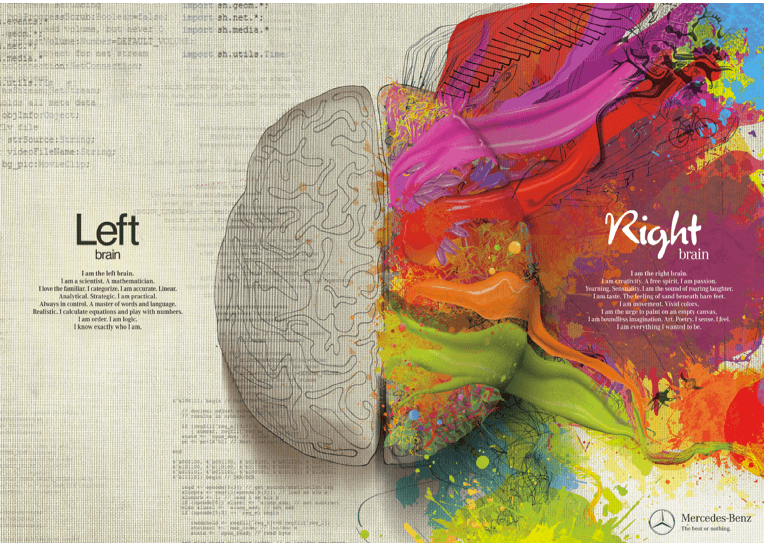
Mercedes-Benz Left Brain, Right Brain Ad Campaign

I love this ad campaign by Mercedes-Benz earlier this year. They created different pictures showing the difference between the left brain and right side of the brain and communicated us that Mercedes-Benz combines the latest technology and superior quality with innovation and emotion. The text in the ads read:

(Left:) “I am the left brain. I am a scientist. A mathematician. I love the familiar. I categorize. I am accurate. Linear. Analytical. Strategic. I am practical. Always in control. A master of words and language. Realis…tic. I calculate equations and play with numbers. I am order. I am logic. I know exactly who I am.”

(Right:) “I am the right brain. I am creativity. A free spirit. I am passion. Yearning. Sensuality. I am the sound of roaring laughter. I am taste. The feeling of sand beneath bare feet. I am movement. Vivid colors. I am the urge to paint on an empty canvas. I am boundless imagination. Art. Poetry. I sense. I feel. I am everything I wanted to be.”


Volkswagen Makes Art You Can Steal

I think VW used some serious brain when they created this fun campaign for Jetta GLI in Canada. VW Canada created several pop-up outdoor exhibits featuring limited edition long-exposure light paintings, created by taillights of the Jetta GLI as it moved. The paintings were hand numbered and VW encouraged people to ‘steal’ them. Soon the paintings started popping back up – but this time on social media networks people showing what they had done with their painting from the pop up exhibit. While I might not agree with the “stealing” message, I love how this campaign was done using both left and right sides of the brain and communicating how much fun VW Jetta is.

Wednesday, October 12, 2011

Edelman's 7 Rules of Public Engagement

In his 2011 PRSA Leadership Rally keynote address, “The Third Way – Public Engagement," Richard Edelman, CEO of Edelman, gave the following counsel on engaging consumers effectively:

1. Listen with new intelligence.
There are new kinds of influentials now, conversation-starters. Cultivate relationships with them.

2. Create galvanizing ideas.
Find something that’s visual and simple. Don’t be biased against an idea. Be creative.

3. Know the socialized approach to media relations.
The media cloverleaf now consists of traditional media, hybrid media, social media and owned media. Broadcast tailored messages across each space with different spokespeople.

4. Create and co-create content.
SEO(Search Engine Optimization) is important, but it won’t help boring content. Use video and other multimedia. “I believe any company can be a media company.”

5. Participate in the conversation.
Conversations happen in real time, all the time. Go where the people are.

6. Build active partnerships for common good.
The new CSR mantra is “immediate justification.”  When consumers buy a product, they want to feel like they’re doing the right thing. Do your part to help.

7. Embrace complexity.
Issues are complex. Embrace a coherent way of thinking about them and analytical methods to identify and address problems.

3 Reasons Why Fluff Pieces are Good or Bad Marketing


Admit it, some of us like reading (or watching) fluff every now and again. Fluff takes us to a world that is not our own reality, and let’s us tune out for a bit.

Fluff pieces are stories that don’t have real value or strong content. They are stories that have fun stories, but serve no real purpose except to entertain.

As I venture into this world of PR and content marketing, learning and writing about best practices on blogging and writing headlines, I notice a lot of fluff out there. Fluff that has managed to receive 40+ “Likes” and reTweets. This made me think about fluff as a form of marketing. Good or bad practice, it is out there, and from the surface, seems to be effective marketing.

Does fluff work?
I have surmised that fluff can be a good marketing strategy, if just to capture initial attention.

Fluff is good marketing:

1) Makes you feel good – Fluff writing doesn’t require a lot of researched data and information. The story tends to be something cutesy or non-consequential. Like an FYI that you can take or leave.

2) Makes you forget current challenges – Alcohol marketers know all about making you forget your present troubles. Notwithstanding that alcohol in itself makes you do that anyway, savvy marketing lets you see the “fun” and party aspect of having a drink. With fluff, you forget, even for a brief moment, present problems. Think about the phenomenon of romance novels and soap operas for so many women.

3) Lets you escape – Tied into my point in #2 above, fluff promotes escapism. Look at an advertisement for a luxury auto. The shots are gauzy, the women and men are insanely hot, and the car makes you feel giddy – all while you are sitting in your living room eating a bowl of popcorn.


However, this is where it gets bad, literally.

1) You get lazy – Since they have no real substance, fluff tends to make you lazy. No fact-checking, no research just makes for a written piece that is sedentary. Since there are no real calls to action to motivate your audience, i.e. to look at your product, sign up for your newsletter, or to even navigate through your website. Fluff pieces are pure brain candy!

2) Doesn’t make you smart or learned – We all know that garbage in, garbage out. Though fluff pieces are fun and exciting, they don’t really bring the reader valuable information. As a blogger, and PR student, I love to read, but I hope to learn from what I read. This is where “content is king” rings true. Articles about Justin Bieber’s hair is pure fluffy fluff! Give me pointers on how to be a blogging sensation that brings me a million dollars by next Friday.

3) Shallow - This summarizes it all. There is nothing truly deep and abiding with a fluff article. The elements of escape from reality and into fantasy does not solve your target audience’s problems or make their lives better. Nothing gained and nothing lost.
The marketing takeaway is that fluff can produce the initial desired result: bring interest to a product or service. Fluff can also be good PR because it makes things look pretty and enticing. But fluff, as the word itself is defined does nothing more than to bring short-term attention. I say use the advantages of a fluff piece, but make sure to back it up with something worthwhile and valuable.

Tuesday, October 4, 2011

Infographic : A simple history of top PR campaigns!

Ever wonder what made PR what it is today? Without first knowing where PR started and where it came from, it is blasphemy (ok, maybe not blasphemy, but it’s still important)! The best part about knowing a little history of PR is that though the principles may be as old as time, the fundamentals still apply: evoking emotions in PR campaigns and creating a call-to-action are only two of many timeless PR campaign tactics you should incorporate into your plan. Check out this infographic for a brief history of top PR campaigns.

(click to enlarge)

Monday, September 26, 2011

5 Lessons from the story of Swiffer

Now Swiffer is a verb! Here are 5 lessons we can learn form the story of Swiffer.
053107swiffer.jpg
1. Demographic changes open up new oppertunities.
The fact that more women work outside the home has increased the level of frustration with household chores, creating an opening for solution like Swiffer.


2. If something is a common problem that everyone recognizes, its solution would be universally embraced.
Everybody hates mopping. Look for ideas hidden in the obvious, the mundane, the negative, and the bothersome.

3. Thoughtful details make the difference between a product women like and a product women love.
Details are what seperate the good fromm the great. A mop that doesn't tip over when you lean it against the wall? Ingenious!

4. How you innovate is just as important as what you innovate.
Watching your customers in their natural habitate may lead you to innovations faster than any simulated environments or well-written research reports.

5. Simplicity matters
If the customer needs a manuual the size of a dictionary to use your product, then you're creating a barrier to women embracing your product. Whatever it is, make it easy to open and operate!